
Lot 99
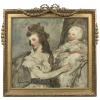


GILBERT STUART (Saunderstown, 1755-Boston, 1828)
PORTRAIT DE WILLIAM BINGHAM (1752-1804)
Toile
Cadre français du XIXe siècle en bois doré
Porte une étiquette XXe au revers du cadre avec une inscription à l'encre "Gilbert Stuart / (Portr)ait . de . William / (Bingh)am . en . habit / (de) chasse"
Porte deux fois le numéro, probablement d'inventaire, au crayon au revers du châssis "6760" ; porte un numéro au crayon au revers du châssis et du cadre "x3"
Portrait of William Bingham (1752-1804), canvas, 19th century French giltwood frame
45 x 46,5 CM - 17,7 x 18,3 IN.
-
Notes:
Provenance
Peint en 1784 pour William Bingham et son épouse Anne Willing ;
Collection Mary Willing Clymer et Henry Clymer (sœur et beau-frère d'Anne Willing Bingham) ;
Par descendance Mis et Mise de Bryas, à la fin du XIXe siècle.
Puis par descendance, jusqu'au propriétaire actuel.
Bibliographie
G. C. Mason, The Life and Works of Gilbert Stuart, New York, 1879, pp. 137-139 ;
L. Park, Gilbert Stuart : An Illustrated Descriptive List of His Works, with an Account of His Life bu John Hill Morgan and an Appreciation by Royal Cortissoz, New York, 1926, pp. 151, 152, 154, 155, n° 80, 81, 84 (date le tableau de 1784 probablement grâce à l'âge de la plus jeune fille née un an auparavant à Londres) ;
M. L. Brown, Mr. and Mrs. William Bingham of Philadelphia, dans The Pennsylvania Magazine of History and Biography, juillet 1937, cité p. 289, reproduit (daté 1784) ;
R. C. Alberts, The Golden Voyage. The Life and Times of William Bingham 1752-1804, Boston, 1969, cité pp. 149, 150, reproduit ;
Catalogue de l'Exposition Gilbert Stuart, New York, Metropolitan Museum of Art, 21 octobre 2004-16 janvier 2005, Washington, National Portrait Gallery, Smithsonian Institution, 27 mars-31 juillet 2005, cité p. 198, p. 203 sous le n° 53 et note 5 ("Anne and William Bingham commissioned a family portait ; the picture was left unfinished…" ; "In London in 1784 or 1785 Stuart began a group portrait of Bingham and his wife, Anne, with theirs daughters Ann Louisa and Maria Matilda, leaving it unfinished, possibly because of a disagreement with Mrs. Bingham about the composition")
Gilbert Stuart compte parmi les tout premiers peintres américains à la fin du XVIIIe siècle. Sa jeunesse est itinérante entre la Côte Est des États-Unis et le Royaume-Uni. Il complète sa formation en Écosse en 1771, à Londres entre 1775 et 1787, où il assiste Benjamin West et devient proche de Joshua Reynolds. Il obtient un grand succès avec son portrait de William Grant en Patineur, exposé en 1782, à la Royal Academy de Londres. Il continue sa carrière à Dublin avant de retourner à Philadelphie en 1794, où il peint George Washington, premier portrait officiel d'un président américain. Il s'impose ensuite comme le principal portraitiste des grandes villes de la Côte Est. Il s'installe à Washington en 1803, devenue capitale officielle des États-Unis et brosse l'effigie des premiers pères fondateurs et des membres de l'administration fédérale.
Anne Willing et William Bingham incarnent deux personnalités marquantes du début de l'histoire des États-Unis. Bingham est d'abord émissaire de l'assemblée législative des treize colonies britanniques. Il joue un rôle crucial dans les relations diplomatiques qui ont conduit à l'Indépendance Américaine. À seulement 40 ans, il devient l'homme le plus riche du pays grâce à ses investissements pendant la Révolution Américaine, incluant l'acquisition de terres dans l'État de New York et la négociation avec la France pour l'achat de la Louisiane. Son épouse, Anne Willing, correspondante de Thomas Jefferson, est connue pour être le modèle de la Lady Liberty sur les premières pièces de monnaie américaines.
A l'âge de 16 ans, Anne Willing se marie avec William Bingham, de douze ans son aîné. Ils donnent naissance à trois enfants : l'aînée, Ann Louisa (1782-1848), la cadette, Maria Matilda, représentée ici avec sa mère tirant sa robe jalouse du regard portée à sa grande sœur et le benjamin, William (1800-1852), qui est né seize ans après la réalisation de notre portrait de famille.
Nos deux toiles datent de 1784 au moment où Bingham et Willing séjournent à Londres. Stuart avait conçu un grand portrait de famille réunissant les parents et leurs deux filles, à la manière de ce type de composition chez Van Dyck et Reynolds. Anne tenait sa fille assise devant elle, jetant un regard réfléchi sur son aînée (le Portrait d'Ann Louisa Bingham se trouve dans une collection particulière, ill.1). William se tient derrière elles, en habit de chasse rouge. Inachevée, la toile est ensuite découpée en trois portraits indépendants par le peintre Thomas Sully.
Nos tableaux sont un rare témoignage des débuts de la peinture américaine de la fin du XVIIIe siècle. La technique libre, esquissée par endroits, enlevée montre le haut niveau de qualité atteint par les premiers peintres du Nouveau Monde.
En 1797, une décennie après l'ambitieux grand format non terminé, les modèles commandent à Stuart, deux portraits à mi-corps en pendant (ill.2, collection privée et Philadelphia Museum of Art) et un portrait de William Bingham en pied (ING Bank, NV, London Branch). Un an auparavant, en 1896, ils avaient demandé à leur peintre un portrait de Washington et l'avait offert au premier ministre anglais William Petty, Lord Shelburne, Marquis of Lansdowne (ill.3), probablement le plus célèbre portrait du premier président. Philadelphie est alors la capitale fédérale entre 1790 et 1800. Les Bingham reçoivent à l'européenne dans la Mansion House, tiennent un salon et organisent des dîners, fréquentés par les membres du gouvernement dont Washington et Jefferson.
Gilbert Stuart was one of the very first American painters at the end of the 18th century. During his youth, he travelled between the East Coast of the United States and the United Kingdom. He completed his training in Scotland in 1771 and in London between 1775 and 1787, where he assisted Benjamin West and became close to Joshua Reynolds. He achieved great success with his portrait of William Grant as an Ice scater, exhibited in 1782 at the Royal Academy in London. He continued his career in Dublin before returning to Philadelphia in 1794, where he painted George Washington, the first official portrait of an American president. He went on to establish himself as the leading portraitist of the major cities of the East Coast. He moved to Washington in 1803, which had become the official capital of the United States, and painted the effigies of the first founding fathers and members of the federal administration.
Anne Willing et William Bingham, who married on October 26, 1780, are two noteworthy figures in the early history of the United States.
William Bingham (1752-1804) was first an emissary of the Legislative Assembly of the thirteen British colonies. He played a crucial role in the diplomatic relations that led to American independence. At the age of 40, he became the richest man in the country thanks to his investments during the American Revolution, including the acquisition of land in New York State and negotiations with France for the purchase of Louisiana. Our portrait, painted in 1784, is the first portrait of William Bingham. Bingham was in England on business, probably commissioned to establish his position and mark the beginning of a great future.
His wife, Anne Willing, a penfriend of Thomas Jefferson, is known as the model for Lady Liberty on the first American coins. Also known as "Nancy", Anne Bingham was one of the most admired American women of her time. She was the eldest daughter of Thomas Willing and Anne McCall. Back in Philadelphia, Anne Bingham held salons in their residence and invited politicians (such as George Washington), artists and scientists.
Our two paintings date from 1784, when William Bingham and Anne Willing were staying in London. Stuart had designed a large family portrait of the parents and their two daughters, Ann Louisa and Maria Matilda, in the style of Reynolds. Anne held her daughter, Maria Matilda, seated in front of her, casting a thoughtful glance at her eldest, Ann Louisa, while William stood behind them in his red hunting costume. Unfinished, the painting was later given by Anne Willing to her sister, Mary Willing Clymer, and then cut into three independent portraits by the painter Thomas Sully : The Portrait of William Bingham ; The Portrait of Anne Willing Bingham and her Daughter Maria Matilda ; and The Portrait of Ann Louisa (now in a private collection).
His free technique, which includes sketches, bears witness to the high level of quality achieved by the first painters of the New World.
In 1797, a decade after the ambitious unfinished large-format portrait, the models commissioned Stuart to paint two half-body portraits of them in pendant (ill.2, private collection and Philadelphia Museum of Art) and a full-length portrait of William Bingham (ING Bank, NV, London Branch). A year earlier, in 1896, they had asked their painter to paint a portrait of Washington and had offered it to the English Prime Minister William Petty, Lord Shelburne, Marquis of Lansdowne (ill.3), probably the most famous portrait of the first president. Philadelphia was the federal capital between 1790 and 1800. The Binghams held European-style receptions in the Mansion House, ran a salon and organised dinners, which were attended by members of the government, including Washington and Jefferson.
Accepted Forms of Payment:
Discover, MasterCard, Visa, Wire Transfer
Shipping
The export of any lot from France or the import into another country may be subject to authorisation (export certificates, customs authorisations). It is the buyer's responsibility to check which authorisations are required. Obtaining export or import certificate is at the sole expense of the buyer.
Purchases can only be collected after the buyer has paid all amounts due in full. In the event of a payment by cheque or bank transfer, delivery of the goods may be deferred until such time as the payment has cleared. In this case, storage costs shall be borne by the buyer and Tajan shall incur no liability whatsoever in this respect.
Tajan's Shipping department is at your disposal to assist you with your shipping. You can contact [email protected] or +33 1 53 30 30 42.
Tajan
View full terms and conditions
| From: | To: | Increments: |
|---|---|---|
| €0 | €99 | €10 |
| €100 | €499 | €20 |
| €500 | €999 | €50 |
| €1,000 | €1,999 | €100 |
| €2,000 | €9,999 | €200 |
| €10,000 | €19,999 | €500 |
| €20,000 | €49,999 | €1,000 |
| €50,000 | €99,999 | €2,000 |
| €100,000 + | €5,000 |